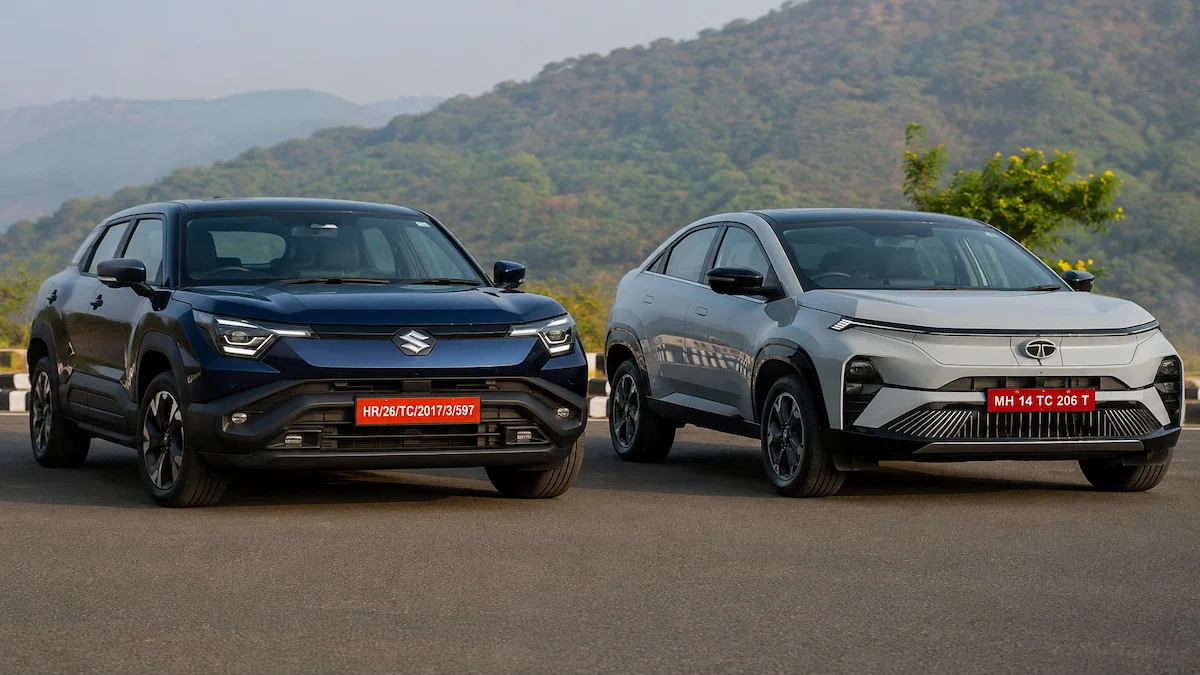
The midsize electric SUV segment in India has transformed into a high-stakes battlefield. For the longest time, Tata Motors ruled the narrative unchallenged. However, the commercial arrival of the Maruti Suzuki e Vitara has thrown a massive wrench into the status quo, challenging the hyper-stylish Tata Curvv EV head-on.
Both cars represent completely different approaches to the same goal: providing a reliable, feature-loaded, long-range premium family vehicle for under ₹25 Lakh.
If you are planning to park one of these inside your garage, which one deserves your hard-earned money? In this detailed Carvoxa comparison, we analyze the three metrics that matter most: Price, Battery Technology, and True Real-World Range.
The Spec Sheet: Head-to-Head At A Glance
| Metric Layer | Maruti Suzuki e Vitara | Tata Curvv EV (SeriesX) |
| Ex-Showroom Price Range | ₹15.99 Lakh – ₹20.01 Lakh (BaaS Option from ₹10.99 Lakh) | ₹16.99 Lakh – ₹19.49 Lakh |
| Battery Pack Options | 49 kWh & 61.1 kWh (Lithium-ion LFP) | 55 kWh (High-Density LFP) |
| Claimed Lab Range | 440 km (49 kWh) / 543 km (61.1 kWh) | 502 km (ARAI) / ~425 km (C75 Cycle) |
| Real-World Range Expectation | 300–350 km (Base) / 380–420 km (Top) | 350–375 km (Combined Test) |
| Peak Power & Torque | 172 bhp / 193 Nm (61.1 kWh) | 165 bhp / 215 Nm |
| DC Fast Charging Time | 10% to 80% in 45 Mins | 10% to 80% in 40 Mins (70 kW) |
1. Price Evaluation: Upfront Math vs. BaaS Subscriptions
When looking directly at standard ex-showroom structures, both vehicles are locked in a fiercely competitive pricing grid.
Ex-Showroom Entry Points (No Battery Subscription)
Maruti Suzuki e Vitara Delta (49 kWh) –> ₹15.99 Lakh
Tata Curvv EV Accomplished X (55 kWh) –> ₹16.99 Lakh (+₹1 Lakh)
- The Maruti Edge: Maruti undercuts the entry-level cost by a clean ₹1 Lakh with its base Delta trim. Furthermore, Maruti plays a unique card by offering an entry-level Battery-as-a-Service (BaaS) ownership model. This slashes the initial entry price to an incredibly accessible ₹10.99 Lakh, requiring you to pay a nominal per-kilometer battery rental fee later.
- The Tata Edge: Tata focuses heavily on packed feature configurations right from the base variant. While it skips the BaaS subscription model entirely, the Curvv EV tops out its luxury variant line at a slightly lower tier (₹19.49 Lakh vs Maruti’s ₹20.01 Lakh for the dual-tone Alpha pack), offering solid value for buyers looking to make a one-time final payment.
2. Battery Engineering: Platform Architecture Matters
The structural differences underneath the floorboard dictate exactly how these two vehicles perform over years of continuous charging stress.
Maruti Suzuki e Vitara: The Ground-Up Born EV
The e Vitara sits on Suzuki’s all-new Heartect-e dedicated skateboard platform. Because it was engineered solely for an electric drivetrain, the weight distribution is impeccably centered, and the cabin lacks a floor hump. Maruti utilizes premium LFP (Lithium Iron Phosphate) chemistry cells divided into two options: a city-focused 49 kWh pack and a long-range 61.1 kWh pack.
Tata Curvv EV: The Modular Platform Strategy
The Curvv EV relies on Tata’s highly advanced acti.ev architecture. It utilizes high-density cylindrical LFP cells integrated heavily into its structure. While the Curvv platform is modular (sharing assembly roots with ICE siblings), the battery placement is incredibly safe, earning a flawless 5-star Bharat NCAP safety score. Tata maximizes output with a highly centralized 55 kWh capacity pack.
3. The Driving Reality: Claimed Range vs. Real-World Mileage
Laboratory driving certificates rarely match the stop-and-go chaos of real-world Indian road conditions. This is where the numbers diverge significantly.
- Maruti Suzuki e Vitara (61.1 kWh): Maruti claims a lab range of 543 km. In our extensive test cycles combining city traffic jams and 100 km/h highway runs, the large 61.1 kWh battery translates to a highly reliable 380 to 420 km of true driving range. The smaller 49 kWh base variant delivers a predictable 300 to 350 km.
- Tata Curvv EV (55 kWh): Tata claims an official ARAI metric of 502 km, while explicitly guiding consumers to expect 400 to 425 km under realistic urban cycles. In real-world multi-mode validation tests (Eco Mode, Regen level 2), the Curvv EV extracts a very respectable 365 to 375 km on a full charge.
The Range Verdict: If absolute long-distance highway cruising is your primary objective, Maruti’s larger 61.1 kWh battery holds a physical edge, squeezing out roughly 30 to 40 kilometers of additional driving breathing room over the Curvv EV.
Carvoxa Buying Verdict: Which Should You Choose?
Go for the Maruti Suzuki e Vitara if:
You prioritize a ground-up born EV platform, want the lowest possible upfront layout via BaaS financing, or need that extra 61.1 kWh battery capacity for intercity road trips. Additionally, Maruti’s sprawling tier-2 and tier-3 service footprint offers unmatched peace of mind if you live outside metro hubs.
Go for the Tata Curvv EV if:
You want a striking, attention-grabbing coupe-SUV silhouette that stands out completely from conventional boxes. It is perfect if you value immediate torque response (215 Nm vs Maruti’s 193 Nm), want massive boot spaces (500 Liters), and favor Tata’s field-tested electronic software environment.
For more refined automotive insights and detailed updates, visit CarVoxa.com