The single biggest roadblock preventing Indian car buyers from transitioning to electric vehicles (EVs) has always been the “EV Tax”—the heavily inflated upfront cost driven by expensive lithium-ion battery packs. In fact, a car’s battery typically accounts for roughly 30% to 40% of its total manufacturing price.
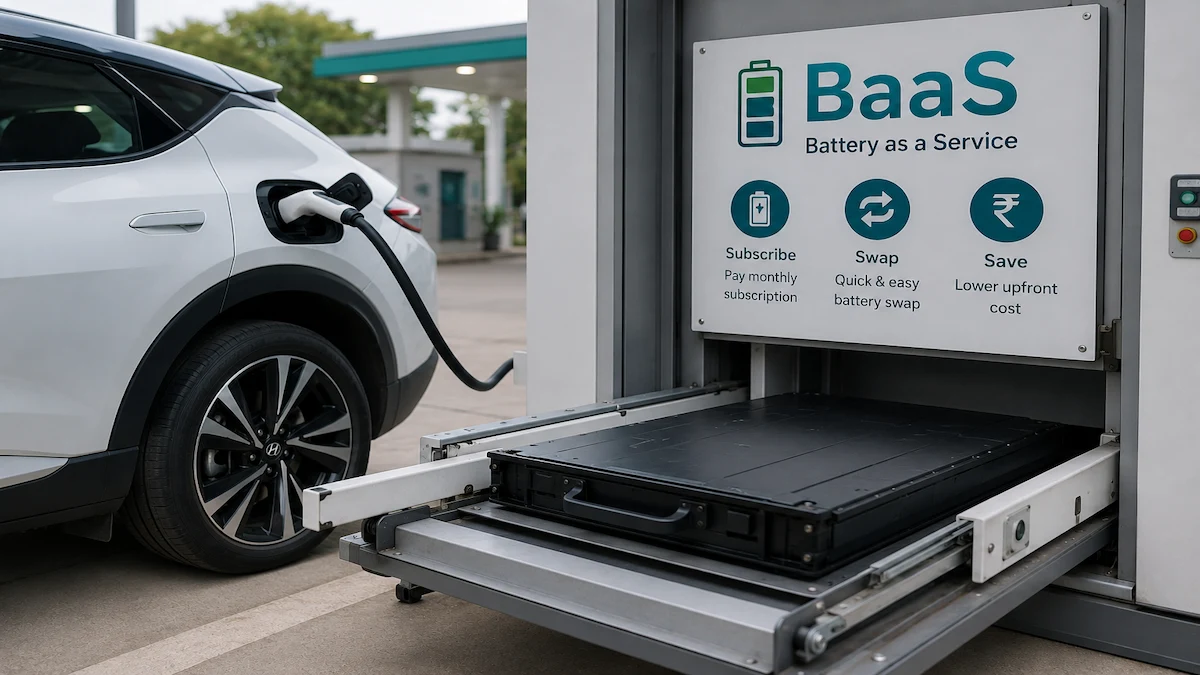
To shatter this affordability barrier, automakers in India have rolled out a disruptive car ownership framework: BaaS (Battery as a Service), also known as Battery as a Subscription.
This innovative approach has completely decoupled the cost of the car from the battery, reducing the initial purchase price of electric vehicles to bring them into direct price parity with petrol and diesel cars.
In this comprehensive Carvoxa Guide, we break down exactly how BaaS works, evaluate the mathematics behind the billing, and list every major car company offering battery subscriptions in India.
What is Battery as a Service (BaaS) and How Does It Work?
Simply put, BaaS is a vehicle rental and financing model where you purchase the physical shell and chassis of the electric car but rent the battery pack.
When you opt for a BaaS-enabled car at a dealership, the financial transaction is divided into two distinct tracks:
Total BaaS Cost Structure
Upfront Outlay –> You pay only for the car body/chassis (Similar to buying an ICE car)
Recurring Rental –> You pay a flexible, mileage-based subscription to a finance partner
Instead of paying a massive lump sum upfront for a component that will naturally degrade over time, you pay a nominal fixed rate per kilometer driven. The battery subscription billing is handled via integrated EV financing players (such as Bajaj Finance, VidyutTech, and Hero Fincorp), who manage the asset risk on behalf of the manufacturer.
The Mathematics of BaaS: Is It Financially Viable?
To understand how the economics balance out, consider an entry-level urban commuter vehicle under the BaaS framework versus traditional full ownership:
| Financial Element | Full EV Ownership Model | BaaS Subscription Model |
| Initial Upfront Price | Higher initial layout (Includes battery) | 30% lower upfront price (Excludes battery) |
| Running Cost Structure | Pure electricity charging costs (~₹1/km) | Fixed rental cost per km + charging costs |
| Battery Health Risk | Borne entirely by the owner after warranty | Zero risk (Maintained/replaced by company) |
| Resale Complexity | Straightforward vehicle transfer | Requires lease transfer to the new owner |
Carvoxa Inside Note: BaaS is highly profitable for city commuters and fleet operators driving between 800 to 1,500 km per month. However, if your annual mileage exceeds 15,000 km, the cumulative per-kilometer subscription fees over five years can occasionally outpace the initial upfront savings. Always compute your monthly driving average before signing a BaaS contract.
How the BaaS Rental System Works: The Mechanics of “₹ per KM”
To understand the day-to-day realities of BaaS, you have to look past the marketing. When an automaker says a vehicle has a battery rental of ₹3.50 per km, it does not mean your car tracks your odometer like a taxi meter and sends you a random bill at midnight.
Instead, the rental system is governed by a structured, usage-linked financing setup. Here is exactly how it functions:
1. The Post-Paid Billing Cycle
When you roll the vehicle off the showroom floor, the car’s onboard telematics system (connected via eSIM) securely tracks your monthly driven kilometers. At the end of the billing cycle, this data is sent directly to the partner non-banking financial company (NBFC) like Bajaj Finance, VidyutTech or Hero Fincorp. They then calculate your usage and auto-debit your linked bank account, exactly like a postpaid mobile phone bill.
2. The Deceptive “Minimum Monthly Cap”
This is the most critical fine print that catches many Indian car buyers off guard. Almost all BaaS providers in India enforce a mandatory minimum usage threshold—typically set at 1,500 kilometers per month.
- If you drive MORE than the cap: If you drive 1,800 km in a month on a ₹3.50/km plan, you pay for your actual usage:
- Calculation: 1,800 km × ₹3.50 = ₹6,300
- If you drive LESS than the cap: If you leave your car parked in the garage for a holiday and only clock 400 km, you are still billed for the baseline 1,500 km minimum. Your bill will remain flat:
- Calculation: 1,500 km × ₹3.50 = ₹5,250
Your Monthly BaaS Bill Breakdown:
- Real-World Driving > 1,500 km: Billed for your exact usage + odometer overage.
- Real-World Driving < 1,500 km: Billed for the flat minimum threshold (1,500 km).
3. Understanding “₹ per KM” vs. Total Running Cost
It is vital to remember that the “₹ per km” subscription fee is strictly a hardware asset rental fee paid to the financier for letting you use their battery. It does not include the electricity needed to fill it up.
Your actual total running cost per kilometer will always be:
- Total Running Cost = BaaS Subscription Fee + Local Charging Cost
For example, if your battery rental is ₹3.50/km and your local home charging adds roughly ₹1.00 to ₹1.50 per km, your true aggregate running cost comes out to roughly ₹4.50 to ₹5.00 per km. While this remains significantly cheaper than a petrol car (which typically averages ₹7.00 to ₹9.00 per km), it highlights why computing your real-world daily commute is absolutely non-negotiable before opting for a BaaS model.
Comprehensive List of Cars Offering BaaS in India
Driven by aggressive mass-market adoption strategies, major players like JSW-MG, Tata Motors, Maruti Suzuki, and Toyota have fully adopted battery subscription architectures.
The complete matrix of BaaS-enabled electric cars in India spans these models:
| Brand & Vehicle Model | Upfront BaaS Price (Ex-Showroom) | Battery Rental Subscription Cost | Non-BaaS Price (Full Ownership) |
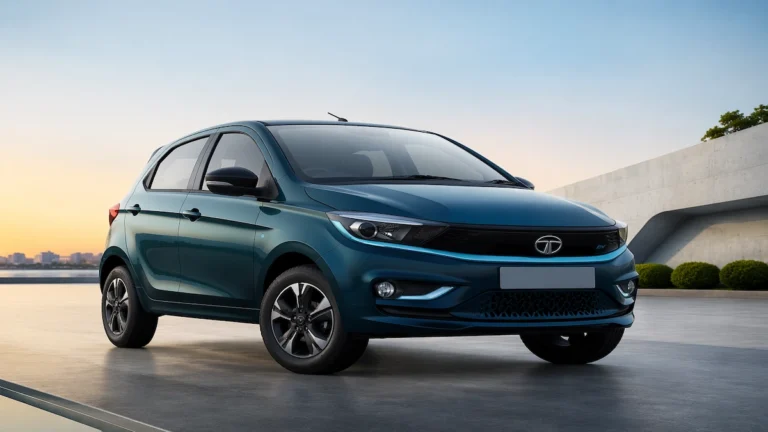
| Tata Tiago EV | ₹4.69 Lakh | ₹2.60 per km | ₹6.99 Lakh onwards |
| Tata Punch EV | ₹6.49 Lakh | ₹2.60 per km | ₹9.69 Lakh onwards |
| MG Comet EV | ₹4.99 Lakh | ₹3.20 per km | ₹7.63 Lakh onwards |
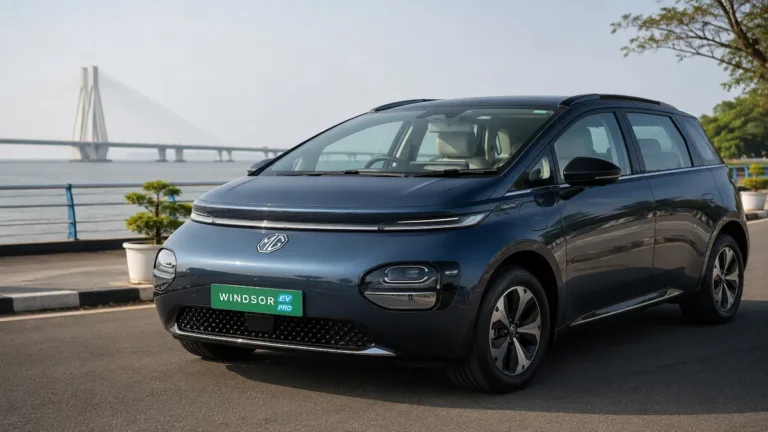
| MG Windsor EV | ₹9.99 Lakh | ₹3.99 per km | ₹14.10 Lakh onwards |
| Maruti Suzuki e Vitara | ₹10.99 Lakh | ₹3.99 per km | ₹15.99 Lakh onwards |
| Toyota Urban Cruiser Ebella | ₹15.25 Lakh | ₹4.99 per km | ₹23.60 Lakh (Top Spec) |
| MG ZS EV | ₹13.00 Lakh | ₹4.50 per km | ₹17.99 Lakh onwards |
The Big Benefits of Battery Subscriptions
- Massive Upfront Savings: As highlighted in the matrix above, cars like the Tata Tiago EV drop down to an incredible ₹4.69 Lakh entry-level point under BaaS—making an electric hatchback cheaper than many standard petrol options.
- Elimination of Battery Degradation Anxiety: EV buyers frequently worry about battery capacity dropping after a few years. Under a subscription framework, the health of the asset remains the manufacturer’s liability. Many brands bundle this with lifetime high-voltage battery warranties.
- Easier Upgrades: As battery energy density improves over the coming years, BaaS subscribers can seamlessly substitute older battery packs for advanced variants without swapping out the entire car.
Also Read: Maruti Suzuki e Vitara vs Tata Curvv EV: The Ultimate Midsize Electric SUV Showdown
For more refined automotive insights and detailed updates, visit CarVoxa.com
Frequently Asked Questions (FAQs)
-
Does the BaaS per-kilometer cost include public charging fees?
No. The BaaS per-kilometer fee is strictly a rental asset charge for the battery pack itself. Standard electricity costs incurred via home charging or public DC fast-charging networks (typically averaging ₹1 to ₹1.5 per km) are paid separately by the driver.
-
Is there a minimum monthly driving commitment or billing under BaaS?
Yes. Most automotive financing partners enforce a minimum monthly usage tier—typically calculated at 1,500 km per month. Even if you drive only 800 km in a given month, you will be billed for the baseline minimum threshold defined in your subscription contract.
-
Can I close the BaaS program and buy the battery permanently later?
Yes. All major manufacturers provide straightforward exit paths. Owners can choose to pay a pre-calculated foreclosure sum to buy out the battery outright from the financing company, transforming the vehicle into a standard full-ownership asset.
-
What happens when I want to resell a BaaS-supported electric car?
When selling the vehicle in the used car market, the active lease contract must be legally transferred to the new buyer via the designated financier. Alternatively, you can buy out the battery pack completely before listing the vehicle for sale.