
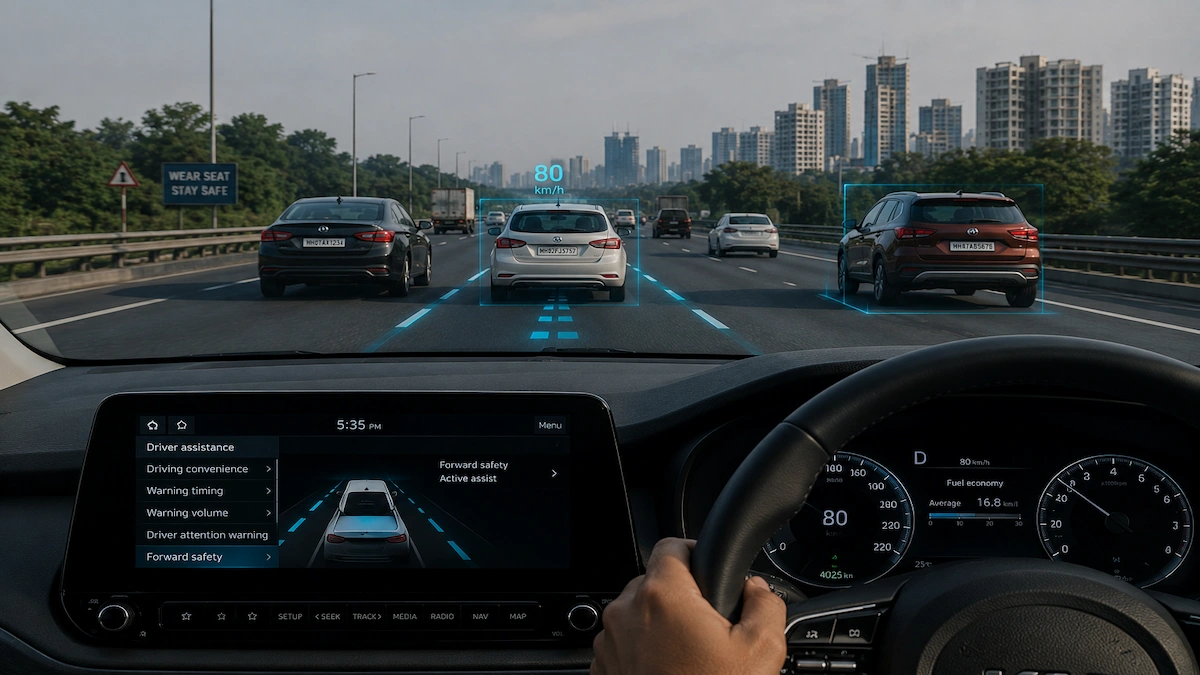
Modern cars are no longer just machines that take people from one place to another. They are rapidly evolving into intelligent mobility systems packed with cameras, radars, sensors and software designed to improve safety, comfort and driving confidence. One of the biggest technologies driving this transformation is ADAS, or Advanced Driver Assistance Systems. In 2026, ADAS has become one of the most talked-about automotive technologies globally, especially as Indian buyers increasingly prioritize safety while purchasing new vehicles.
From automatic emergency braking and lane-keeping assist to adaptive cruise control and blind-spot monitoring, ADAS is changing how drivers interact with vehicles. What was once available only in expensive luxury cars is now gradually reaching mainstream hatchbacks, SUVs and EVs in India. Automakers such as Hyundai, Tata Motors, Mahindra, Honda, MG, Kia, Toyota and even luxury brands are aggressively integrating ADAS into their latest models to improve road safety and compete in a technology-driven market.
The growing demand for ADAS is also linked to rising awareness about vehicle safety ratings, accident prevention and driver fatigue reduction. As traffic congestion increases and highways become faster, buyers are now looking for cars that can actively assist them during stressful driving conditions. In simple words, ADAS acts like an intelligent co-driver that continuously monitors the surroundings and helps reduce human errors on the road.
What Is ADAS?
ADAS stands for Advanced Driver Assistance Systems. It is a collection of electronic technologies designed to assist drivers while driving or parking a vehicle. ADAS uses cameras, radar sensors, ultrasonic sensors, LiDAR (Light Detection and Ranging) and advanced software algorithms to detect surrounding vehicles, pedestrians, road signs and lane markings in real time.
The primary purpose of ADAS is to improve vehicle safety, reduce accidents and make driving more convenient. Some systems only warn the driver, while more advanced systems can automatically apply brakes, steer the vehicle or control acceleration in certain situations.
For example, if a vehicle suddenly brakes ahead, ADAS can detect the risk of collision and either warn the driver or automatically apply emergency braking if the driver fails to react quickly. Similarly, lane-keeping assist can gently steer the car back into its lane if the vehicle unintentionally drifts.
ADAS technologies are considered a major stepping stone toward fully autonomous or self-driving vehicles. Although most cars in 2026 still require human drivers, ADAS already enables semi-autonomous functions in many premium vehicles.
How Does ADAS Work?
ADAS systems rely on a network of hardware and software components working together continuously.
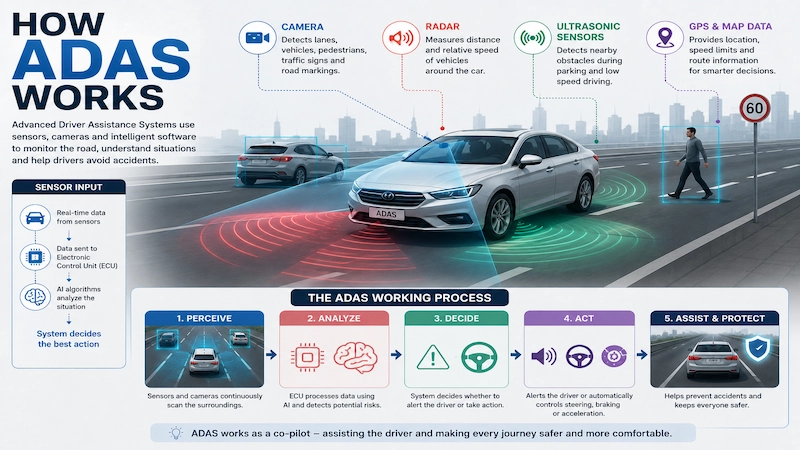
Main Components Used in ADAS
| Component | Function |
|---|---|
| Cameras | Detect lanes, vehicles, pedestrians and traffic signs |
| Radar Sensors | Measure speed and distance of nearby vehicles |
| Ultrasonic Sensors | Assist in parking and close-range detection |
| LiDAR (Light Detection and Ranging) | Creates 3D mapping of surroundings (mainly premium vehicles) |
| ECU (Electronic Control Unit) | Processes sensor data and controls actions |
| GPS & Maps | Support navigation and route-based assistance |
The system constantly gathers real-time data from the surroundings. Artificial intelligence and advanced algorithms then analyze the information and decide whether to warn the driver or intervene automatically.
Types of ADAS
ADAS technologies are generally divided into two major categories: Active ADAS and Passive ADAS.
1. Active ADAS
Active ADAS systems can actively intervene in vehicle operation to prevent accidents or assist the driver.
Examples of Active ADAS
| Active ADAS Feature | Function |
|---|---|
| Autonomous Emergency Braking (AEB) | Automatically applies brakes during collision risk |
| Adaptive Cruise Control (ACC) | Maintains safe distance from the vehicle ahead |
| Lane Keep Assist (LKA) | Helps keep the vehicle within lane markings |
| Blind Spot Monitoring | Detects vehicles in blind spots |
| Traffic Sign Recognition | Reads and displays traffic signs |
| Automatic High Beam Assist | Switches between high and low beam automatically |
| Rear Cross Traffic Alert | Detects vehicles while reversing |
| Driver Attention Warning | Detects drowsy driving behavior |
These systems reduce driver workload and improve overall safety during long-distance driving and highway cruising.
2. Passive ADAS
Passive ADAS systems mainly provide warnings and alerts without directly controlling the vehicle.
Examples of Passive ADAS
| Passive ADAS Feature | Function |
|---|---|
| Forward Collision Warning | Alerts driver about possible collision |
| Lane Departure Warning | Warns when vehicle leaves lane |
| Parking Sensors | Detect nearby obstacles |
| Tyre Pressure Monitoring System (TPMS) | Monitors tyre pressure |
| Rear View Camera | Assists while reversing |
| Seat Belt Reminder | Alerts occupants to wear seat belts |
Passive systems are considered the first level of driver assistance and are now becoming common in affordable vehicles.
Major Applications of ADAS
ADAS is used in multiple real-world driving situations. Its applications continue expanding as automotive software becomes more advanced.
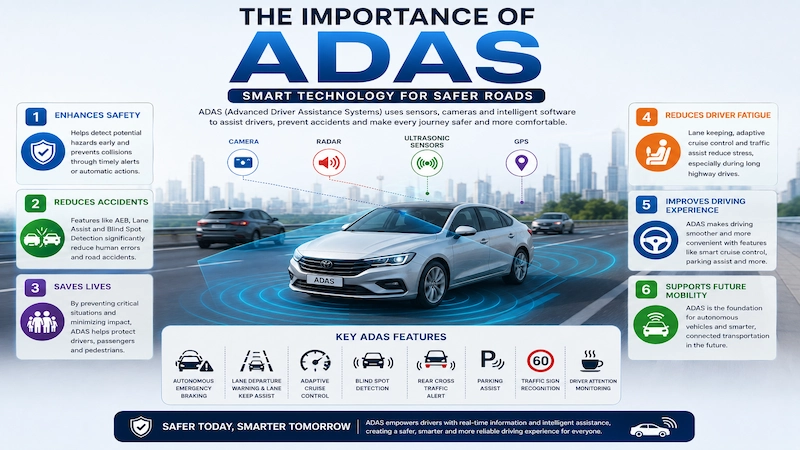
1. Highway Driving Assistance
ADAS significantly reduces stress during highway driving. Adaptive cruise control maintains speed automatically, while lane centering helps keep the vehicle stable within lanes.
2. Urban Traffic Safety
In city traffic, automatic emergency braking and pedestrian detection systems help reduce low-speed collisions and improve safety in crowded environments.
3. Parking Assistance
Parking cameras, 360-degree surround view systems and automatic parking assist make parking easier, especially in tight urban spaces.
4. Night Driving Support
High beam assist and driver monitoring systems improve visibility and reduce fatigue during night journeys.
5. Fleet & Commercial Vehicles
ADAS is increasingly used in trucks, buses and logistics vehicles to improve safety, reduce accidents and optimize fleet operations.
Benefits of ADAS
The popularity of ADAS is growing because it offers practical real-world advantages beyond marketing claims.
1. Improved Road Safety
The biggest advantage of ADAS is accident prevention. Many road accidents happen because of delayed human reactions, distractions or fatigue. ADAS can respond faster than humans in critical situations.
2. Reduced Driver Fatigue
Features like adaptive cruise control and lane centering reduce driver stress during long highway trips.
3. Better Parking Convenience
Parking assist systems help drivers park confidently in congested urban areas.
4. Lower Insurance Risks
Vehicles with advanced safety technologies may reduce accident probability, potentially lowering insurance risks in the future.
5. Enhanced Driving Confidence
New drivers often feel more confident using vehicles equipped with parking sensors, blind spot monitoring and lane assistance systems.
6. Foundation for Autonomous Cars
ADAS is the technological base for future autonomous vehicles. As systems become more advanced, cars will gradually move toward higher automation levels.
Limitations of ADAS
Although ADAS improves safety, it is not perfect and should never replace responsible driving.
Common Limitations
| Limitation | Explanation |
|---|---|
| Weather Sensitivity | Heavy rain or fog can affect sensors |
| Poor Road Markings | Lane assist may fail on faded roads |
| Driver Overconfidence | Some drivers rely too heavily on technology |
| High Repair Costs | Sensors and cameras are expensive to repair |
| Traffic Complexity | Indian roads present unpredictable conditions |
ADAS works best as an assistance system, not a replacement for attentive driving.
Levels of Vehicle Automation
ADAS technologies are categorized into automation levels defined globally by SAE (Society of Automotive Engineers).
| Level | Description |
|---|---|
| Level 0 | No automation |
| Level 1 | Basic assistance like cruise control |
| Level 2 | Partial automation with steering & acceleration support |
| Level 3 | Conditional automation |
| Level 4 | High automation |
| Level 5 | Fully autonomous driving |
Most ADAS-equipped cars in India currently operate at Level 1 or Level 2 automation.
Cars With ADAS in India in 2026
ADAS is no longer limited to luxury brands. Several mainstream cars in India now offer advanced driver assistance features.
Popular Cars With ADAS in 2026
| Car Model | ADAS Availability |
|---|---|
| Hyundai Creta | Level 2 ADAS |
| Hyundai Verna | Level 2 ADAS |
| Hyundai Venue | ADAS Available |
| Tata Nexon | ADAS in top variants |
| Mahindra XUV700 | Advanced ADAS package |
| Mahindra Scorpio N | ADAS Expected in future updates |
| Honda Elevate | Honda Sensing ADAS |
| Honda City | Honda Sensing |
| MG Hector | Level 2 ADAS |
| MG Astor | AI-based ADAS |
| Kia Seltos | ADAS Available |
| Kia Sonet | ADAS Available |
| Toyota Hyryder | ADAS in select variants |
| BYD Atto 3 | Advanced safety suite |
| BMW 5 Series | Premium ADAS |
| Mercedes-Benz E-Class | Advanced autonomous assistance |
ADAS in Electric Vehicles
Electric vehicles are rapidly adopting ADAS because EV architectures are more software-oriented. Brands like Tesla, BYD, Hyundai, Kia and Mercedes are combining electric mobility with advanced driver assistance technologies to create smarter vehicles.
Indian EV makers are also expected to expand ADAS availability as buyers demand more premium technology features.
Future of ADAS in India
The future of ADAS in India looks extremely promising. Increasing awareness about safety, stricter regulations and growing competition among automakers are accelerating adoption.
Several trends are expected in the coming years:
- More affordable cars will receive ADAS
- Better AI-based pedestrian detection systems
- Improved highway automation
- Connected vehicle communication
- Integration with smart infrastructure
- More advanced driver monitoring systems
As roads and infrastructure improve, ADAS will become a standard safety expectation rather than a luxury feature.
Why ADAS Matters More Than Ever
India records a large number of road accidents every year, many caused by human error, fatigue and distraction. ADAS technologies have the potential to significantly reduce such incidents by supporting drivers during critical moments.
For modern buyers, ADAS also represents peace of mind. Whether driving on highways, navigating traffic or parking in crowded cities, intelligent safety systems make driving easier and safer.
Automakers are now using ADAS not just as a premium feature but as a core selling point. In 2026, buyers increasingly compare vehicles based on safety technology alongside mileage, design and performance.
Advanced Driver Assistance Systems are transforming the automotive industry by making vehicles smarter, safer and more intelligent. From collision prevention and lane assistance to adaptive cruise control and autonomous emergency braking, ADAS technologies are redefining modern driving experiences.
What was once limited to expensive luxury sedans is now entering mainstream Indian cars, SUVs and EVs. As technology evolves further, ADAS will continue becoming more affordable and widespread across segments.
For buyers planning to purchase a new car in 2026, ADAS is no longer just an optional technology feature. It is quickly becoming an essential safety system that can improve driving confidence, reduce accidents and prepare the automotive world for the future of autonomous mobility.
FAQs
What is ADAS in cars?
ADAS stands for Advanced Driver Assistance Systems. It includes technologies like automatic emergency braking, lane assist and adaptive cruise control designed to improve driving safety and convenience.
Is ADAS available in affordable cars in India?
Yes, several affordable and mid-range cars in India now offer ADAS features, including the Hyundai Venue, Kia Sonet, Tata Nexon and Honda Elevate.
What is the difference between active and passive ADAS?
Active ADAS can intervene automatically by braking or steering, while passive ADAS mainly provides warnings and alerts to the driver.
Can ADAS prevent accidents completely?
No. ADAS helps reduce accident risks but cannot fully prevent all crashes. Drivers must remain attentive at all times.
Which sensors are used in ADAS?
ADAS mainly uses cameras, radar sensors, ultrasonic sensors, LiDAR and electronic control units.
Which car has the best ADAS in India?
Vehicles like the Mahindra XUV700, Hyundai Verna, MG Hector and luxury German cars currently offer some of the most advanced ADAS packages in India.
Also Read: Hyundai i20 2026 Spotted Testing Again – Premium Hatchback May Get Big Design & Tech Upgrades
For more refined automotive insights and detailed updates, visit CarVoxa.com